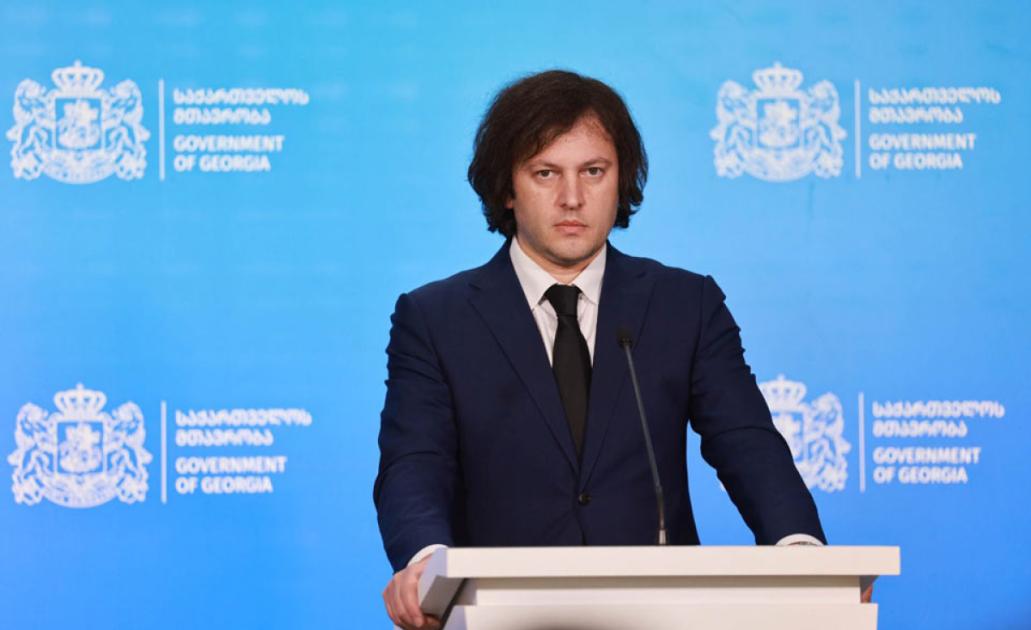




“Between 2021 and 2025, our economy grew at an average rate of 9.3 per cent, even as global trade slowed and uncertainty intensified,” Prime Minister of Georgia, Irakli Kobakhidze, stated at the World Government Summit 2026 in Dubai.
According to the Head of Government, Georgia has preserved macroeconomic discipline, protected investor confidence, and maintained peace in one of the world’s most complex regions.
“At a time when many were forced to react, Georgia chose to plan with ambitious projects. Transport and logistics are forming the backbone of the national economy and supporting trade-led development. Georgia has committed 7 billion USD to the comprehensive overhaul of its transport infrastructure, and we regularly spend 7%-8% of GDP on Capex annually. We have completed the full modernisation of our core railway network, doubling capacity and substantially reducing transit time across the country.
Rail connectivity has been further strengthened through the Baku–Tbilisi–Kars railway, which provides a direct and reliable rail link between the Caspian Basin and international markets through Georgia,” the Prime Minister has said.
Speaking in Dubai, Irakli Kobakhidze described the current state of international trade, arguing that the world’s commercial architecture is being reshaped by political conflict rather than market forces.
“We gather here in Dubai at a moment when the world’s commercial routes are being redrawn not by the invisible hand of market economics, but by the very visible fist of geopolitics. Consider what has happened to global trade in just the past few years. The northern corridors that once carried goods efficiently between Europe and Asia have been severely affected by the war in Ukraine.
Supply chains that took decades to build were disrupted overnight. Businesses that planned for efficiency suddenly found themselves planning for survival. Look eastward, and we see Pacific trade routes increasingly politicised by the Great Power tensions. Tariffs, sanctions, and strategic decoupling have transformed what was once the world’s most dynamic commercial relationship into a complex geopolitical contest,” Irakli Kobakhidze said.
According to the Prime Minister, even the most traditional partnerships now face unprecedented friction.
“Trade disputes and policy differences have introduced uncertainty to once-stable relationships. This is not the economic globalization we once knew. We are entering a new chapter one where geography matters again, where stability becomes a competitive advantage, and where the ability to maintain relationships across divides is not a diplomatic nicety, but an economic necessity. The question before us today is not whether this transformation is happening – it clearly is.
The real question is how we respond. How do we build a trading system resilient enough to withstand geopolitical shocks, yet open enough to continue delivering prosperity?
In a world where traditional routes are unreliable, alternative corridors become essential. In a fragmented global economy, countries capable of bridging divides become invaluable. And in an era of uncertainty, stability itself becomes a strategic asset. The world does not need less trade – it needs more resilient trade. It does not need isolation – it needs intelligent diversification. And it does not need to choose sides – it needs reliable bridges between them,” Irakli Kobakhidze emphasised.
The Head of the Government also paid attention to the value and importance of the Middle Corridor.
“This brings us to the Middle Corridor, which is no longer simply an option, but an imperative for global commerce,” he said.
“The Middle Corridor, connecting East Asia to Europe through Central Asia, the Caucasus, and Türkiye, offers something increasingly rare in today’s world: a stable, reliable transit route that transcends geopolitical divides. Genuine stability is not merely the absence of conflict, but the presence of strong institutions, predictable policies, and a demonstrated commitment to peace even amid regional tensions.
In an era of polarisation, diplomatic capacity is equally central: the ability to maintain constructive relationships across political and strategic divides has become an economic advantage. This institutional and diplomatic foundation must be matched by well-developed infrastructure: modern highways, ports, and railways that enable goods to move not only faster, but reliably and predictably,” Irakli Kobakhidze said.
Georgia’s credentials, the Prime Minister argued, extend beyond geography.
“Georgia’s relevance is not defined by its location alone, but by what it has done with that location. Over the past decade, Georgia has demonstrated that stability is a deliberate policy choice.
Black Sea Submarine Cable initiative, selected by the European Commission as a project of Mutual Interest (PMI), aims to connect Georgia with European electricity systems and position the country as a crucial energy transit hub between Europe and the South Caucasus. We are advancing the Anaklia Deep Sea Port project, an infrastructure of strategic importance designed to handle large container vessels and dramatically expand port capacity in the Black Sea. Anaklia is not only a port; it is a platform for scaling up transit volumes, attracting global shipping lines, and reinforcing the Black Sea’s role as a competitive gateway between Europe and Asia.
We believe that trade facilitation is as important as physical infrastructure; therefore, Georgia puts great emphasis on efficient border procedures, predictable transit, and streamlined cross-border flows. Ambitious infrastructure projects coupled with an efficient regulatory framework and regional cooperation form an integrated ecosystem designed not for short-term gain, but for long-term resilience.
According to the PM, Georgia’s trade policy reflects its ambition to bridge divides.
“Georgia’s experience confirms a simple principle: peace creates predictability, predictability creates investment, and investment creates growth. What truly distinguishes Georgia is not only what we have built, but how we engage with the world. With free trade agreements with the European Union, China, Türkiye, EFTA countries, and the CIS, we provide access to more than 2.3 billion consumers. In an age defined by rival blocs, Georgia has chosen connectivity over confrontation. We do not ask partners to choose sides. We offer a platform where cooperation remains possible. Our institutional performance reflects this openness,” the PM stated.
Irakli Kobakhidze argued that the country’s business environment rankings support these claims.
“In the World Bank’s Business Ready 2025 ranking, Georgia is among the top four of 101 countries, alongside Korea, Singapore, and Estonia. It ranks second globally for operational efficiency and dispute resolution, and fourth for business location. According to the Fraser Institute’s Economic Freedom of the World 2025, Georgia ranks 25th out of 165 countries worldwide. In the NUMBEO Crime Index 2025, Georgia is among the top 20 safest countries globally.
All of this translates into a favourable environment for investment, business growth, and overall economic stability. Investor confidence is growing. The recent $6.6 billion Eagle Hills investment signals that global capital sees Georgia not only as a transit point but as a long-term partner for logistics, development, and innovation. The Middle Corridor is not merely an alternative route; it represents a model for how trade can adapt to geopolitical realities without surrendering to them.
Georgia, linking continents and serving as a key transport and connectivity hub for seven landlocked countries of the Caucasus, the Caspian Sea region, and Central Asia, invites governments, investors, and business leaders to collaborate in building resilient supply chains – ones that reduce risk while expanding opportunity, and that respond to fragmentation by creating connections.
There is a corridor where goods, data, energy, and capital move predictably across continents, where infrastructure is secured through cooperation rather than constrained by politics, and where peace is not only a principle, but also a deliberate economic strategy. In a fragmented world, prosperity does not arise from walls; it arises from bridges. Today, more than ever, the wealth of nations depends on those who build them. Georgia stands ready to be one of those bridges,” the Prime Minister of Georgia concluded.
0
0