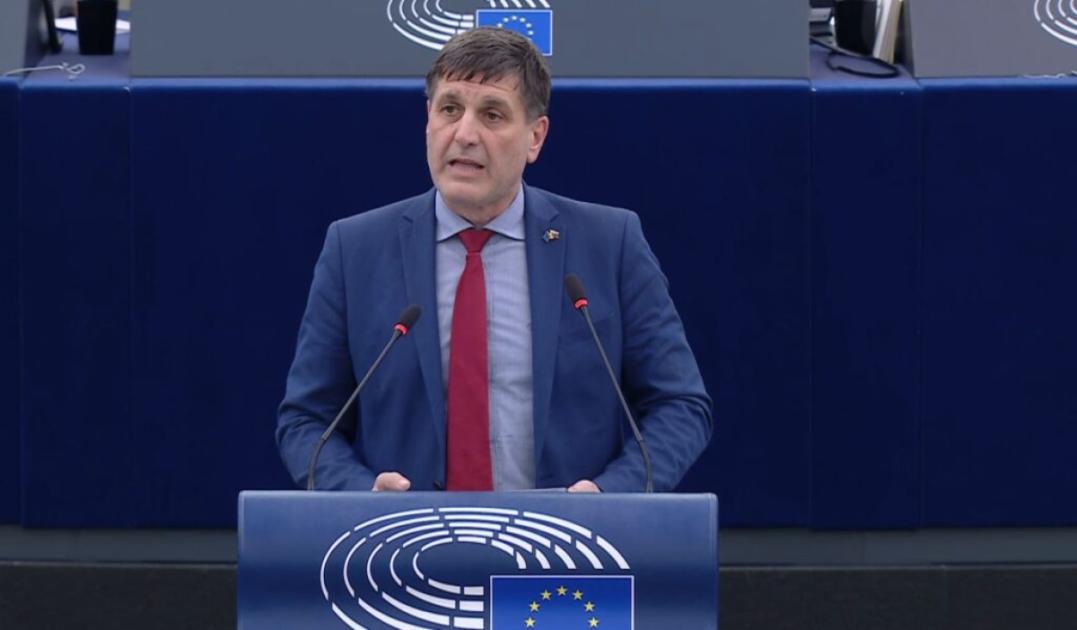




Addressing the European Parliament during the debate on the “Deepening Democratic Crisis in Georgia,” MEP Branislav Ondruš argued that any meaningful response to the situation in Georgia must begin with a reassessment of past EU actions.
Ondruš said the turning point came when Georgia, once seen as a promising EU candidate, was effectively cast as an adversary—at a moment when, in his view, the Georgian government shifted course and the EU began influencing the country’s electoral process. He stressed that the European Union must act fairly, set fair conditions, acknowledge its own mistakes made three years ago, and reinitiate dialogue with Georgian authorities.
Highlighting Georgia’s security and economic constraints, Ondruš noted that the EU cannot provide the energy supplies Georgia needs, which it currently imports from Russia, without risking a shutdown of the Georgian economy. He recalled that Russia has occupied roughly one-fifth of Georgia’s territory for the past two decades, while the EU has continued to trade extensively with Russia throughout that period.
He also underlined Georgia’s vulnerable security position, warning that Russian forces could reach Tbilisi within 48 hours and that, as a non-NATO member, Georgia lacks security guarantees from either NATO or the EU. Under these circumstances, he argued, Georgia has little choice but to avoid provoking Russia.
Concluding his remarks, Ondruš reiterated that change in Georgia requires a fairer EU approach, including clear and balanced conditions, recognition of past errors, and renewed dialogue. Emphasizing the EU’s greater power, he urged European leaders to match strong rhetoric with concrete action, warning that failure to do so would leave ordinary Georgian citizens as victims of what he described as an unrealistic EU foreign policy.
0
0