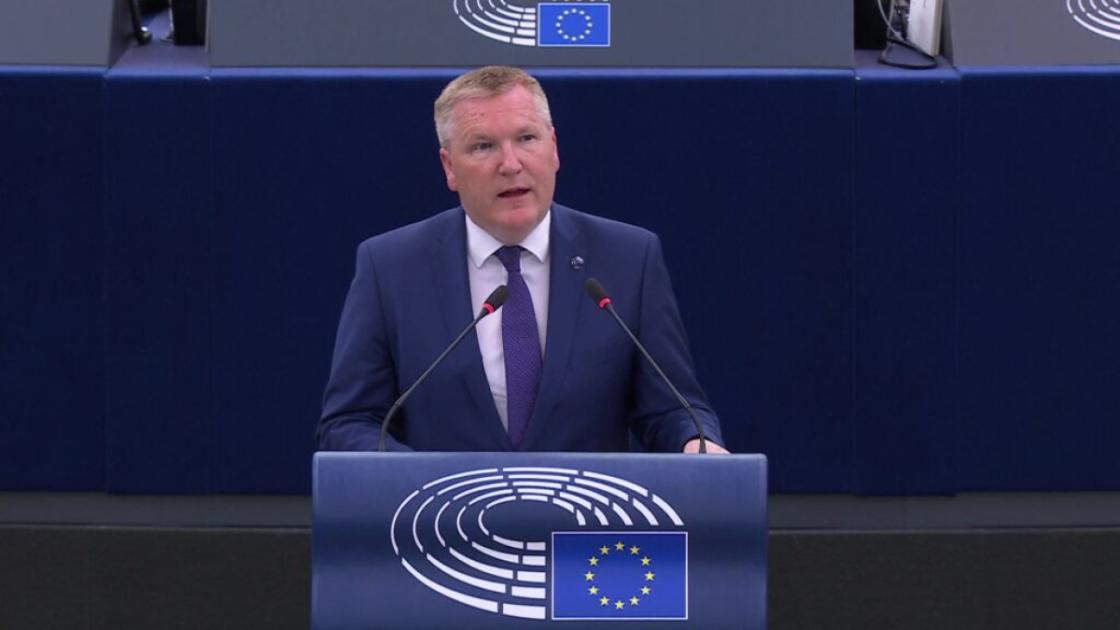




Addressing the European Parliament during the debate on the “Deepening Democratic Crisis in Georgia,” EU Commissioner for Democracy, Justice, the Rule of Law and Consumer Protection Michael McGrath expressed strong support for Georgian citizens striving for a democratic and European future.
“We support the Georgian people as they continue to demand a democratic European future,” McGrath said, noting that citizens are defending their fundamental rights and freedoms despite the risks they face. He argued that under the ruling Georgian Dream party, the country is drifting away from democratic norms.
According to the Commissioner, Georgia is experiencing a systematic assault on democratic institutions and fundamental rights. He pointed to the EU enlargement report published on November 4, which, he said, provides a clear assessment of the country’s democratic regression and the authorities’ increasingly hostile rhetoric toward the EU.
McGrath described the situation as unprecedented for an EU candidate country, citing the rapid erosion of the rule of law, the adoption of restrictive legislation, the instrumentalization of the judiciary, and the shrinking space for civil society. He recalled that when Georgia was granted EU candidate status, it was expected to serve as a catalyst for meaningful reforms. Instead, he argued, the authorities have taken steps that risk depriving Georgian citizens of a European future.
He urged the Georgian government to view the enlargement report as an opportunity to reflect, change course, rebuild trust, and return to the EU path, stressing that the country’s future ultimately lies in the hands of its leaders.
McGrath added that recent developments have only reinforced the EU’s concerns. He cited a constitutional lawsuit filed by the ruling party against three opposition parties, criminal charges against opposition figures, an intensified crackdown on civil society, and legislative steps to criminalize participation in protests. At the same time, he said, senior officials and pro-government media have escalated anti-EU rhetoric and disinformation aimed at undermining the Union’s credibility among Georgian citizens.
In response to Georgia’s democratic backsliding, McGrath said the EU has reduced political engagement with the authorities and suspended bilateral assistance that directly benefits them. He also warned that Georgia continues to fall short of the human rights and rule-of-law benchmarks linked to its visa-free regime, with the Visa Suspension Mechanism Report due to be published later in the week.
He noted that new visa suspension rules will come into force by the end of the year, giving the EU additional options to respond. Discussions on potential sanctions against those responsible for democratic backsliding and human rights violations are ongoing. At the same time, the EU has stepped up support for civil society, contracting an additional €24 million since October last year to assist civil society organizations and independent media in Georgia.
Despite the increasingly restrictive environment, McGrath emphasized that the EU will continue to support pro-democracy civil society, human rights defenders, independent media, and citizens across the country. He said the EU will also ensure that Georgians are informed about the Union’s continued support, shared democratic values, and the opportunities available should the authorities reverse course.
He concluded by reaffirming that the EU stands with the Georgian people, stressing that the door to EU accession remains open if Georgia’s authorities demonstrate a clear commitment to reversing democratic backsliding and returning to the European path.
0
0